
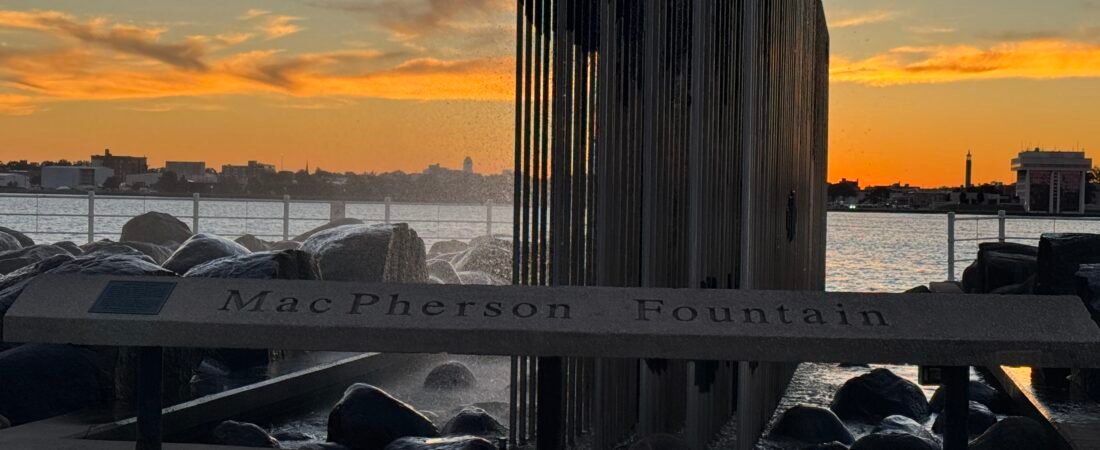
When the sun is setting over the Detroit River and gives the horizon a brilliant golden-orange colour, a remarkable combination of urban and natural beauty can be seen along the waterfront in Windsor, Ontario. At the edge of the water there is a monument which serves not only as a work of public art but also as a strong link between the city’s industrial past and its desire to create community space. This is the MacPherson Fountain, a kinetic sculpture that stands out against the background of the distant United States skyline. The view from this position, which is bordered by a concrete bench clearly bearing the name “MacPherson Fountain”, provides not only a peaceful place for observation but also a deep opportunity for reflection on Windsor’s complicated identity.
The MacPherson Fountain is a unique structure, different from the large circular waterfalls which are commonly seen in city parks. It has a brutalist and skeletal appearance, consisting of tall vertical metal rods and panels that rise like a steel screen. The design serves as a reference to the manufacturing capabilities of a border city and also has a practical purpose; when the pumps are switched on, the vertical effect is enhanced by the flowing water, which produces a curtain of moving fluid. However, it is at golden hour—as vividly shown in this picture—that the fountain really changes. The low angle of the sun passes through the fine mist and the spaces between the metal slats, resulting in a shifting display of light and shadow, as well as fire and water. At this time the MacPherson Fountain acts as a lens and a filter for the dramatic shift from day to night, being set between rough boulders and a carefully maintained promenade.
The MacPherson Fountain goes beyond being just an engineering achievement and has an important socio-environmental role; it is a key element of Windsor’s plan for redeveloping its waterfront, converting a shoreline that could have remained underused and industrial into a lively area suitable for pedestrians. The fountain not only acts as a visual focus but also creates an auditory atmosphere, the flowing water successfully masking the surrounding city noise and thus making it a highly valuable place for urban relaxation. Understanding this fountain means understanding how well-thought-out, site-appropriate art can reconfigure and give a new meaning to a city’s relationship with its waterways, turning a merely functional riverbank into a destination that holds emotional and community significance.
The MacPherson Fountain: An Architectural Lens for Urban Respite and Coastal Identity
We have already outlined the basic purpose of the MacPherson Fountain on Windsor’s waterfront—namely, its function as a link between the area’s industrial heritage and public space—and it is now necessary to look in detail at the engineering and architectural features that have made this structure a successful example in terms of functionality, especially during the important transition period known as the golden hour. While the earlier section dealt with its significance, this section concentrates on the way the fountain’s physical design achieves the difficult urban objective of providing a place of respite.
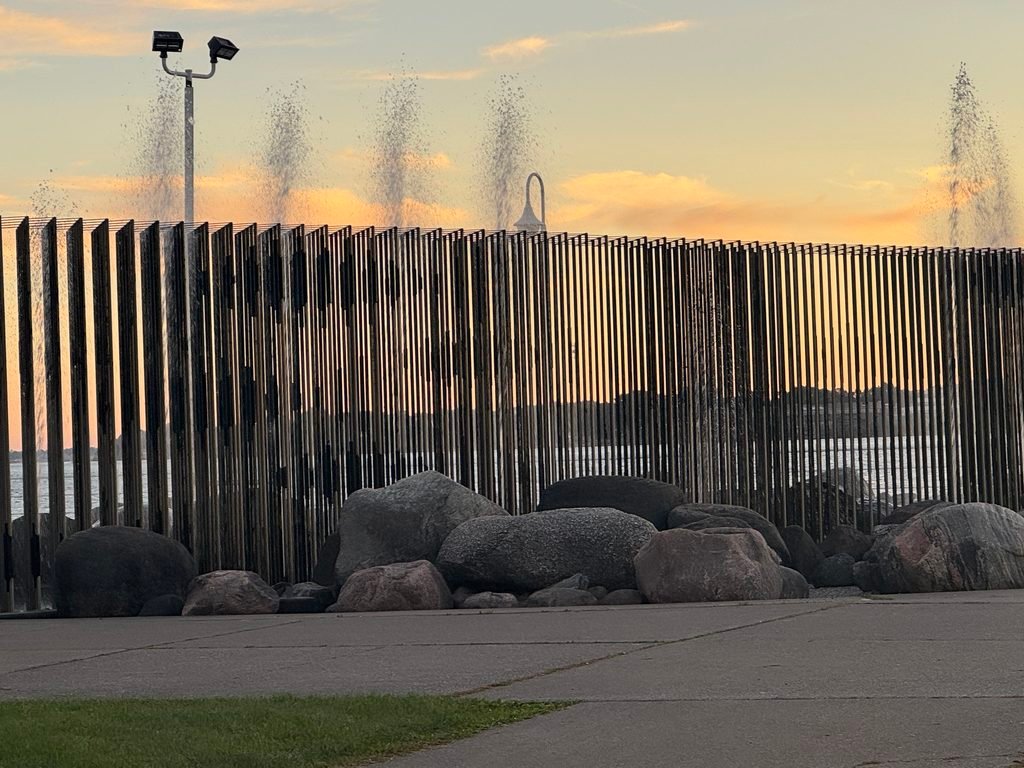
A close look at the geometry of the fountain shows that it follows a highly deliberate design approach. It is not a single, solid structure but rather a carefully arranged set of thin, vertical metal rods. This decision is important since a solid wall would have formed a jarring obstruction between the pedestrian walkway and the Detroit River. In contrast, the multiple-layered grid offers partial transparency. As the twilight grows (as can be seen in image_1.png), this partial transparency enables the remaining gold and peach tones of the sunset to pass through the structure. A moiré pattern is thus produced—a dynamic, moving visual effect for people walking alongside it—one that corresponds to the rhythmic motion of the water. Because of this design, the structure does not appear overwhelming but instead acts as a permeable filter for both natural light and wind.
Above all, this engineering serves the fountain’s main purpose: providing both an acoustic and a spatial escape. The high-pressure, aerated jets visible in image_1.png are deliberately arranged to ensure a certain volume and density. Although their main aim is not merely to create a visual effect, it is to act as an acoustic mask. The continuous, high-volume flow produces a kind of sound — specifically, white noise — which successfully isolates the waterfront area from the remaining hum of the surrounding city. As a result, the concrete and stone plaza becomes an acoustic sanctuary, allowing people to talk and enjoy quiet reflection in a normally busy part of the city.
The hardscape in the area, particularly the big, rough boulders situated at the base of the fountain (as can be seen in image_1.png), has two functions. On an aesthetic level, these natural-shaped rocks offer a suitable visual contrast to the rigid geometry of the metal screen. On a practical level, they function as splash dissipators by breaking the high-velocity water flow returning from the fountain and thus avoiding a excessive amount of mist that could make the promenade slippery and thereby guaranteeing public safety. The security lighting that is built in and visible in the top-left portion of image_1.png makes sure that the fountain continues to be a safe and appealing centre long after the sun has set. In the end, the MacPherson Fountain is an excellent example of merging aesthetic permeability with strong environmental functionality, demonstrating that site-specific, utilitarian engineering is essential if high-value urban spaces are to be created.
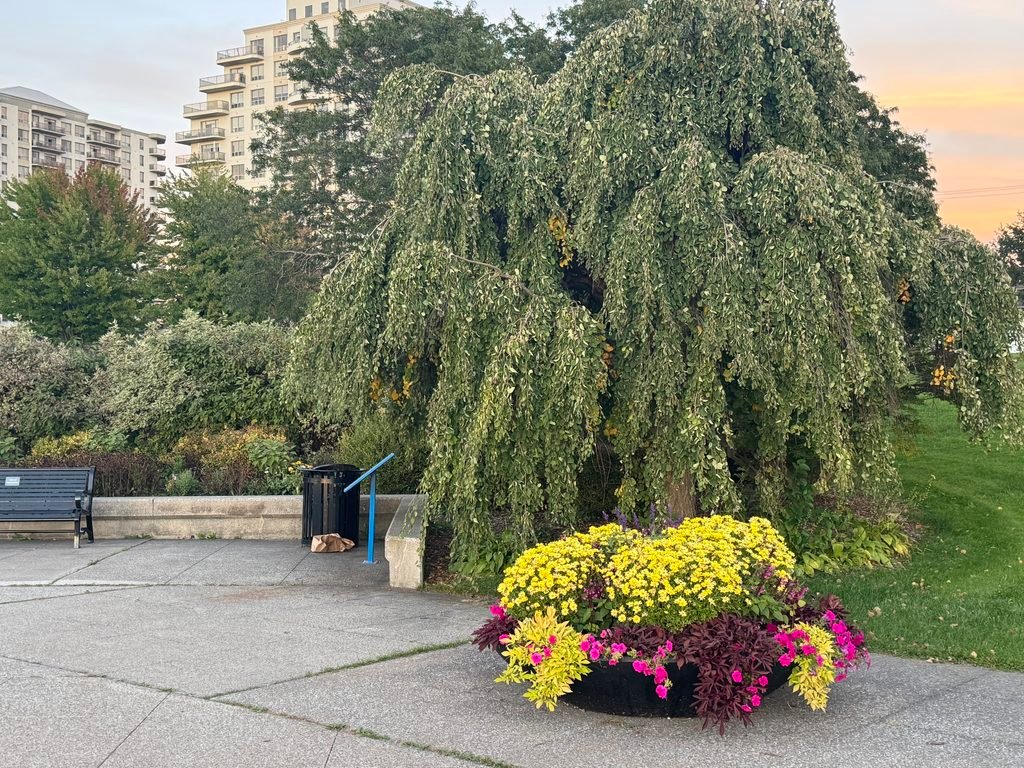
The horticultural design and integration with the landscape along the waterfront promenade goes a long way towards transforming the hard surfaces into a pleasant public space. As can be seen in image_3.png, the concrete promenade is surrounded by carefully chosen botanical features which provide aesthetic appeal all year round and also offer important microclimatic advantages. The most prominent feature in this part of the park is a mature weeping European beech (Fagus sylvatica ‘Pendula’) or a similar type of weeping canopy, the dense, green, drooping leaves of which form a natural architectural arch. This weeping shape has an important role in the design since its low-hanging branches soften the hard, geometric outlines of the adjacent high-rise residential buildings and at the same time give a thick, natural barrier that hides the surrounding urban environment.
At ground level, the park makes use of raised planters containing vivid seasonal flowers to create clear focal points for pedestrians. The planting arrangement shown in image_3.png includes a mixture of bright yellow chrysanthemums, deep magenta petunias, lime-green sweet potato vine (Ipomoea batatas), and dark purple coleus. This carefully selected colour scheme produces a strong visual contrast with the subdued, textured gray pavers of the walking surface. In addition to their decorative value, these raised planters have a practical urban function in that they function as passive traffic-calming barriers, visually separating the areas where there are heavy-duty wooden benches from the main pedestrian path.
Moreover, the inclusion of facilities such as out-of-sight waste bins, informative plaque stands, and accessible paved paths shows that a full site design has been put in place. The lush lawn on the right provides a permeable area for stormwater management, thus reducing the amount of runoff that enters the nearby river ecosystem. By combining striking flower displays, wide shade trees, and sturdy urban furniture, the park authorities have established a multi-layered ecosystem. The balance between the dynamic water features, the dense organic canopies, and the vibrant seasonal colours means that the waterfront serves not only as a visual landmark but also as a fully developed, multi-sensory urban refuge.
Conclusion: The Lasting Legacy of the MacPherson Fountain
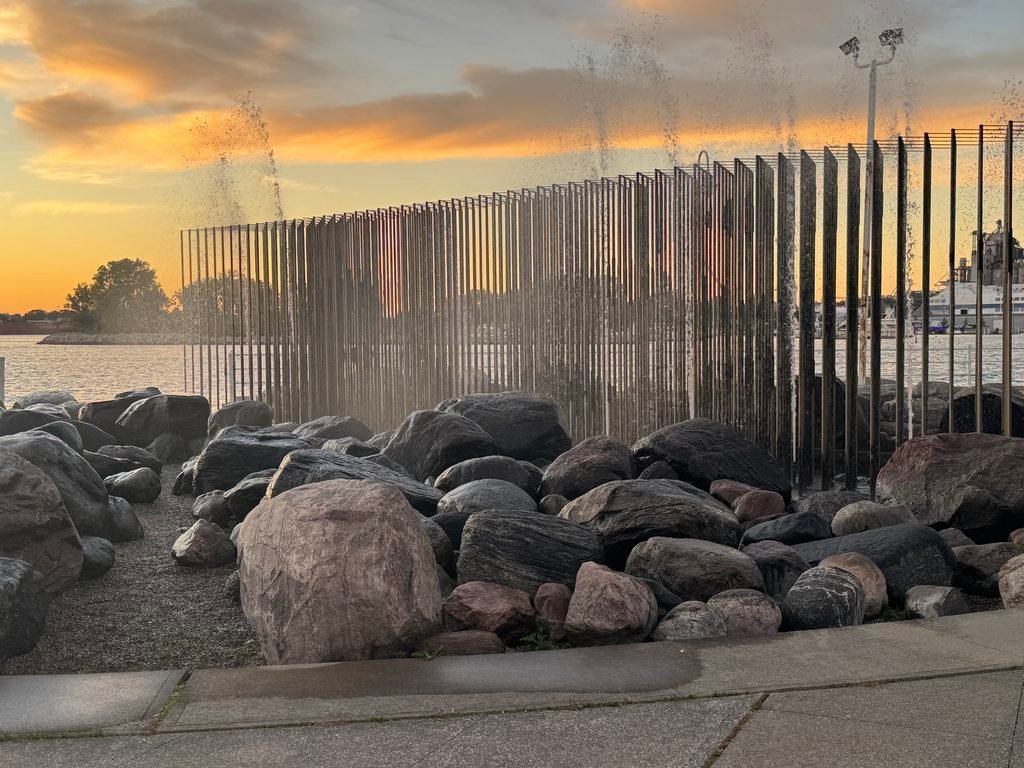
When twilight has completely settled across the international border and our in-depth examination of Windsor’s most important waterfront area comes to an end, the MacPherson Fountain stands as a clear example of careful urban renewal. Throughout this series we have shown how public installations go beyond being just decorative and become useful parts of the civic infrastructure. The last visual view shown in image_4.png brings this combination to a perfect conclusion by illustrating the harmonious interaction between engineered features and natural elements. The vertical metal screen of the MacPherson Fountain, together with the lively water jets that are aerated, still creates a sense of kinetic energy against the quiet background of the setting sun. At the base of the structure, the carefully placed dark, weathered stones secure it to its shoreline setting, reducing water turbulence while providing a tactile, organic contrast to the precisely cut metal slats. This intentional contrast means that the installation remains visually interesting from all angles and gives pedestrians an immersive sensory experience.
In the end, the redevelopment of this waterfront area demonstrates that modern cities can successfully turn their industrial boundaries into lively public spaces. By incorporating acoustic masking, microclimatic horticultural planning, and durable public facilities, the MacPherson Fountain site provides long-term value to both locals and visitors. It encourages ongoing community involvement and acts as a lasting symbol of design excellence along the Detroit River.
Article Reference & Credits
Publisher & Media Owner: Curated Scope (https://curatedscope.com/)
Content Creator / Author: Curated Scope
Photography Credits: All photographs and visual media featured in this article were captured by Curated Scope and are protected under copyright.
Licensing & Usage: No part of this text or image content may be reproduced, republished, or redistributed without explicit written permission and proper source attribution back to Curated Scope