
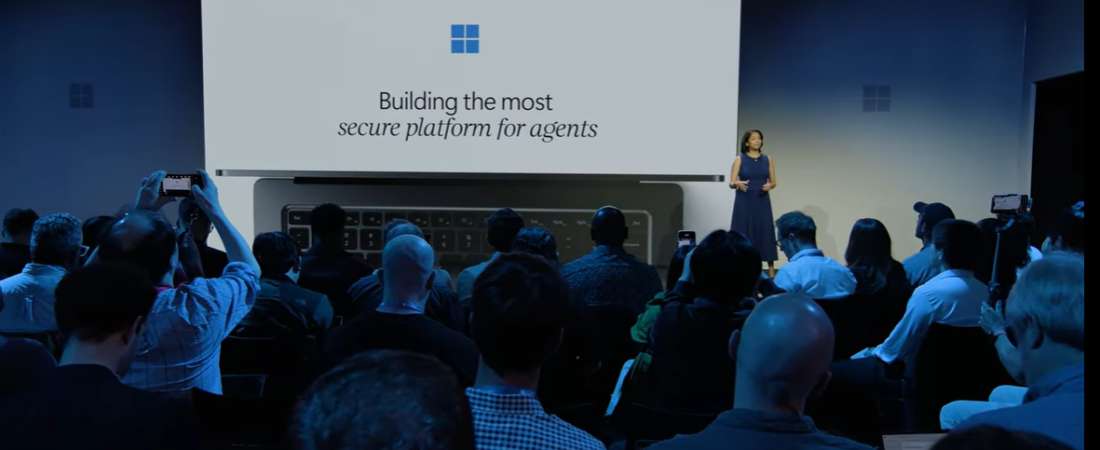
A fundamental change is taking place in the field of personal computing. When Microsoft and NVIDIA held a major event in San Francisco, they presented a common vision which transforms the way operating systems, local hardware, and cloud intelligence interact. Instead of depending entirely on huge cloud data centres or on limited local processing, Microsoft has launched the Windows Agentic Platform, this platform being based on Hybrid Intelligence, including enterprise-grade security features, and a hardware ecosystem driven by the new NVIDIA RTX Spark platform.
The aim of this long-term collaboration is to move computing away from simple chat interfaces and towards the use of autonomous, secure AI agents which are able to carry out complex workflows directly on your PC, with costs, privacy, and performance being carefully controlled.
The Shift from Apps to Autonomous AI Agents
For many decades operating systems have followed an approach which is centred on applications, consisting of human users directly manipulating elements of the user interface, starting programs, and managing files. The fact that AI agents—that is, models capable of reasoning, calling tools, and carrying out multi-step tasks independently—have become more widespread means that the internal structure of operating systems needs to be fundamentally rewritten.
If AI agents are to carry out their tasks locally, granting them direct access via a standard user account presents serious security risks since a malicious prompt, a harmful script, or an untrusted payload might end up compromising the host system or carrying out unwanted administrative actions.
In order to meet this challenge, Microsoft has introduced new primitives at the operating system level which are intended to isolate, monitor, and control autonomous AI workflows directly within Windows 11.
- Trust and Containment: Microsoft Execution Containers (MXC)
Security is a fundamental component of the new Windows Agentic Platform, and Microsoft has announced the general availability (GA) of Microsoft Execution Containers (MXC) on Windows 11 and Linux.
Key Capabilities of MXC:
MXC includes a dynamically managed execution sandbox, the access at runtime of resources, folders, network endpoints, and local APIs being determined by operating system policies.
There is a distinct agent identity: Windows assigns an agent identity at the operating system level, which is separate from the account that is logged into the system.
With targeted remediation, since agent activity is separated from that of humans, enterprise security software (such as Microsoft Defender) is able to detect, record, and isolate malicious actions by agents without causing the user to be locked out of their system or disrupting their ongoing work.
It is possible for IT departments to set up central rules regarding security, data access, and the use of FinOps tokens through Agent 365, after which Windows will enforce these policies on the devices that are managed.
Developers and enterprise security teams are able to run agents such as OpenClaw, GitHub Copilot, Anthropic, and the OpenAI models without compromising local data integrity by incorporating containment directly into the Windows kernel and into user space—ranging from light process-level sandboxes to full Virtual Machines.
- Hybrid Intelligence: The combination of local NPUs and GPUs with cloud-scale capabilities
A major obstacle to the scaling of AI adoption is its economic and computational nature since cloud token budgets are limited but demand from users for continuous AI reasoning is essentially unlimited. This bottleneck is addressed by Hybrid Intelligence via intelligent workload routing.
The new Windows architecture evaluates every prompt and task for complexity, execution cost, latency, and privacy requirements:
Simple or high-volume tasks are routed locally so that they can be carried out on the device’s silicon (using an NPU, GPU, or CPU). Carrying out the processing locally results in no token costs, extremely low latency, and the ability to function offline.
When complex frontier reasoning is required, the data is sent securely to cloud-based large language models because in such cases raw scale and a very large number of parameters are strictly necessary.
Local Model Optimization Milestones
To support complex local reasoning, Microsoft and industry partners announced major optimizations in model size and context length:
The MAI Code 1.1 Flash version has been quantized to 3-bit precision, which reduces the model’s footprint by almost 80% and at the same time maintains all of its full-stack coding capabilities within a remarkable 256K local context window.
The NVIDIA Nemotron (2-bit / 20GB) is specifically designed for use with local RTX Spark hardware and has a small memory footprint.
The DeepSeek V4 (1.6-bit / 60GB) can be run completely on local devices that have high-capacity unified memory, and it achieves better results than the traditional benchmark baselines when used offline.
The Windows ML Runtime has been updated so that Windows ML now has native support for llama.cpp, which means that developers are able to access open-source models from day one with the benefit of GPU and NPU acceleration.
- Practical Applications: Copilot, Coding, and Workflows
Hybrid Intelligence is directly incorporated into the main Windows user interfaces, changing the way everyday tasks and software development are managed.
Advanced Taskbar Search & OS Actions
Windows 11 search is expanding beyond basic file indexing to support direct execution:
The system’s control options (such as Dark Mode, Do Not Disturb, and the microphone volume sliders) can be switched on or off instantly.
You can carry out task management, snap windows, take screen captures, and carry out direct messaging all without having to leave the keyboard or pick up your mobile device.
Supercharged Copilot Capabilities
The unified Copilot experience leverages three distinct local layers:
Grounding the responses in all the local files, documents, and system context (this is similar to the functionality provided by Work IQ at the enterprise level).
Carrying out file moves, reorganising folders, creating archives, and making configuration changes using finely graded user permissions.
By using local models, routine tasks such as sorting tax records, extracting data from receipts, and drafting emails can be delegated to models located on the device, thus keeping all sensitive personal information entirely offline.
GitHub Copilot & Developer Canvas
In developer workflows GitHub Copilot makes use of intelligent auto-routing, with various sub-agents being able to run background tasks such as code cleanup, package updates, or scripts for reproducing issues across huge codebases by working locally in airplane mode and processing millions of context tokens at no cost to the developer.
- Hardware innovation: the Surface Laptop Ultra and the RTX Spark ecosystem
Such major software advances call for specialized computing platforms with high density; Microsoft has launched the Surface Laptop Ultra, which has been designed for the use of AI developers, graphics professionals, and programmers.
Surface Laptop Ultra Specifications:
The processor is based on NVIDIA’s custom RTX Spark platform and has a fused dual-chip structure which provides up to 1 Petaflop of AI computing power.
Unified Memory: The system’s unified memory can be scaled up to 128 GB, which allows developers to load large frontier models directly into RAM.
Thermal and power efficiency: The device has a thermal capacity that is 2.5 times greater so as to handle prolonged high-performance workloads, and it maintains more than 99% of its full processing speed when running on battery power.
Display and Connectors: It features a next-generation PixelSense Ultra touch display, a wider range of ports, and introduces Magnetic Connect—a high-speed magnetic charging system that leaves the standard USB-C ports available for use with external devices.
Ecosystem & Supercomputing Hardware
The RTX Spark ecosystem, which also includes the Surface Laptop Ultra, comprises top-end devices from a number of partners such as Lenovo, Dell (with the XPS 16), MSI (with the Prestige 16), and HP (with the Omnibook Ultra 16).
For institutional research and large-scale agent orchestration, Microsoft and NVIDIA introduced workstation-class local hardware:
The DGX Station for Windows (for example, the Dell Precision Pro and HP ZGX) is an enterprise-grade desktop supercomputer designed to run local trillion-parameter models and acts as a “local token factory” by being able to carry out dozens of autonomous sub-agents at the same time within enterprise-controlled security boundaries.
REFERENCES:
Video: Something new is coming from Windows | October 7
Video URL: http://www.youtube.com/watch?v=ilmBGeGldrI
Source: Windows, (published on: 2026-10-07)
Summary: In San Francisco, Satya Nadella, Pavan Davuluri, Jensen Huang, and the Microsoft/GitHub engineering leaders announce the future of the Windows Agentic Platform. The main announcements are Microsoft Execution Containers (MXC), which enable secure sandboxing of agents and identity attribution; Hybrid Intelligence, which routes AI tasks between the local silicon and the cloud; quantized local models (MAI Code 1.1 Flash, Nemotron, DeepSeek V4) that can run without incurring any token costs; deep integration of agents into Windows Search and Copilot; and the flagship Surface Laptop Ultra, powered by the NVIDIA RTX Spark platform, which provides up to 1 Petaflop of local computing power.